
Skilled sewing machinists are critical to Australia’s furnishing, textile manufacturing and automotive industries. Demand for these skills currently outstrips supply. The Industrial Sewing Skill Set provides entry level skills and an important pathway into work. This project will develop a nationally scalable training model to support its delivery.
Click across the tabs to view active and completed project stages. Consultation takes place at every stage of the project.
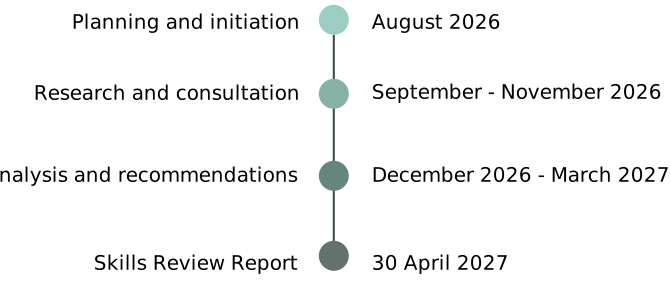
Consultation and research will be undertaken as part of this project to better understand challenges with sewing machinists training pathways, unpacking the barriers for learners, training providers and industry. Findings will be used to develop a training model to support more consistent and workplace-aligned delivery of the Industrial Sewing Skill Set, strengthening its role as both an entry pathway into employment and a bridge to progression into relevant qualifications.
Women, culturally and linguistically diverse (CALD) learners, First Nations people and individuals with low foundation skills already form a large part of the sewing machinist workforce. This project recognises their contribution and focuses on uplifting and supporting learners to progress their skills and careers, while strengthening sewing machinist roles as a viable pathway.
If you are interested in getting involved, please contact [email protected].
Consultation approach
A Working Group is guiding consultation and development of the training model. Broader stakeholder input will be encouraged at the Broad Consultation and Consensus Gathering stages via workshops, surveys and individual consultations. Input is encouraged from:
We are particularly keen to hear from culturally and linguistically diverse (CALD) people, First Nations peoples, women, and those with low foundation skills.
If you are aware of an organisation or key stakeholders who should be involved, please let us know.
Project scope and design
This project will develop a nationally scalable training model to support delivery of the Industrial Sewing Skill Set. At the completion of the project, the training model will be made available for free use by training providers and industry.
Relevant training pathways
MSTSS00015 Industrial Sewing Skill Set contains the following units, preparing workers for entry level roles:
These units have been used in the delivery of the following qualifications and align with their competency requirements:

Background
In 2024-25, the Textiles, Clothing and Footwear Workforce Insights Project highlighted the need to build the skills of the existing workforce and attract new entrants to the industry. This project responds to those reccomendations, taking a closer look at building the capacity of the sewing machining workforce.
Synthesis report
Updated 12/10/26:
This synthesis report brings together research on workforce demand and supply, training pathways and approaches to attracting, training and supporting new entrants into industrial sewing work. It outlines the key findings and recommendations informing consultation and co-design of a more sustainable entry-level pathway for sewing machinists.
Broad consultation is now open until 2 November 2026
This project is seeking feedback on a series of discussion papers and research reports examining workforce challenges and opportunities for Australia’s sewing machinist industry.
The Australian sewing machinist workforce is small, ageing and difficult to replace, with employers reporting challenges in attracting and recruiting people with the industrial sewing skills needed to support production and business growth. Research found that existing training and workforce pathways are not producing enough job-ready sewing machinists to meet industry demand.
Australia’s sewing machinist workforce plays a critical role across the textiles, clothing, footwear, furnishing, upholstery, automotive and marine trimming sectors. This project is exploring practical solutions to strengthen workforce attraction, training and retention pathways. We invite industry stakeholders, workers, training providers and community organisations to review the consultation materials and provide feedback to help shape future workforce development initiatives.
Demand and Supply of Sewing Machinists in Australia – examines workforce demand, training participation, demographics and recruitment challenges. It identifies a gap in current mechanisms to replenish Australia’s sewing machinist workforce.
Review of training programs and initiatives – reviews Australian and international programs supporting entry level sewing machinists and identifies the optimal approaches for training, employer engagement, workplace learning, mentoring and learner support.
Building Australia’s Next Sewing Machinists Workforce – Discussion paper – proposes a National Entry-Level Sewing Machinist Workforce Development Initiative.
Register for a webinar
Motor Trimming – Wednesday 30 Sep 11am-1pm
Upholstery and Furniture – Friday 2 Oct 2-4pm
General Stakeholder Consultation 1 – Wed 21 Oct 11am-1pm
General Stakeholder Consultation 2 – Fri 23 Oct 1:30-3:30pm
Note: all times are listed in AEST
We are particularly interested in feedback on:
- Current and future workforce demand for sewing machinists.
- The effectiveness of existing training pathways.
- Barriers that prevent people entering or remaining in sewing machinist roles.
- The proposed National Entry-Level Sewing Machinist Workforce Development Initiative.
- Appropriate training pathways, timeframes and delivery methods.
- Workplace learning and employer participation requirements.
- Workplace coaching and supervision arrangements.
- Learner support and wraparound services.
- Potential pilot locations and industry sectors.
- Governance, funding and evaluation approaches.
Feedback received through consultation will be reviewed by TextileWorks and used to refine the proposed model, identify industry priorities and inform recommendations for future workforce development initiatives and pilot projects.
Submit feedback via: [email protected]
Subscribe for updates
If you would like to receive updates about this project, please subscribe to our newsletter and select ‘Textiles, clothing and footwear’ as one of your industries of interest.

TextileWorks, a part of ForestWorks, is providing support for the management of this JSC project as part of their collaborative partnership with Skills Insight. ForestWorks has an enduring and strong connection working with the forestry, timber, paper, fibre and furnishing industries and have been engaged by Skills Insight to deliver this project in partnership.