
Advances in technology, evolving building requirements and shifts in domestic manufacturing are reshaping the skills needed across Australia’s glass and glazing industry. Industry stakeholders have identified gaps in current training products, particularly in relation to emerging skills and specialised occupations. This project will review the Certificate II and III in Glass and Glazing, and a selection of related units and skill sets, to ensure they reflect contemporary industry practice and support future workforce needs.
Click across the tabs to view active and completed project stages. Consultation takes place at every stage of the project.
Through targeted consultation, this project will examine how training products can better support emerging skills across fabrication, installation and glass processing, while creating more flexible pathways for specialised occupations.
It will consider the ongoing suitability of the Certificate II qualification and assess how changes to Australia’s domestic glass manufacturing industry have impacted workforce skills and training needs.
Project scope
This project entails a comprehensive review of the Certificate II and Certificate III in Glass and Glazing in line with the Training Package Organising Framework 2025. A selection of related glass and glazing units and skill sets will be reviewed.
Training package products for review include:
two qualifications
two skill sets
seven Leadlight and Stained Glass (DG) units
- MSFDG2001 Assemble leadlight and stained glass components
- MSFDG3001 Protect leadlight and stained glass
- MSFDG3002 Prepare and install architectural engineered leadlight and stained glass
- MSFDG3003 Paint and fire glass
- MSFDG3004 Assemble copper foil glass components
- MSFDG3005 Fuse glass
- MSFDG3006 Process coloured and textured glass by hand
one Furniture Making (FM) unit
twenty eight Glass and Glazing (GG) units
- MSFGG2011 Glaze and reglaze residential windows and doors
- MSFGG2012 Operate glass freefall rack and table
- MSFGG2013 Move single glass sheets by mechanical means
- MSFGG2014 Cut thin glass by hand
- MSFGG2015 Process glass by basic machines
- MSFGG2016 Assemble glazing products
- MSFGG2017 Fabricate and install insect and security screens
- MSFGG3022 Construct and repair leadlight panels
- MSFGG3023 Apply and handle films
- MSFGG3024 Form glass
- MSFGG3025 Apply patterns and designs to glass
- MSFGG3026 Laminate glass
- MSFGG3027 Toughen glass
- MSFGG3028 Select, cut and process materials for glazing products
- MSFGG3029 Assess glass and glazing requirements
- MSFGG3030 Process glass by automatic machines
- MSFGG3031 Cut thick glass
- MSFGG3032 Mirror glass
- MSFGG3033 Install shower screens
- MSFGG3034 Install residential windows and doors
- MSFGG3035 Install mirrors and glass splashbacks
- MSFGG3036 Install commercial glazing products
- MSFGG3037 Install structural glazing products
- MSFGG3038 Conduct commercial and structural reglazing
- MSFGG3039 Manually move glass
- MSFGG3040 Move block and bulk glass sheet by mechanical means
- MSFGG3041 Manufacture insulated glass units
- MSFGG3042 Process glass by semi-automatic machines
MSF Furnishing Training Package Companion Volume Implementation Guide.
Where industry evidence identifies skills gaps or emerging occupational requirements, new training products may be developed, including new units, skill sets and specialisations within the Certificate III in Glass and Glazing.
Relevant occupations
This project relates to occupations across glass fabrication, processing, manufacturing and installation, including:
- Glazier
- Glass and Glazing Tradesperson
- Commercial Glazier
- Residential Glazier
- Structural Glazing Installer
- Glass Processor
- Glass Machine Operator
- Insulating Glass Unit (IGU) Fabricator
- Glass Fabrication and Machining Technician
- Glass Manufacturing Worker
- Window and Door Installer
- Shower Screen Installer
- Commercial Glass Installer
- Retrofit Glazing Specialist
- UPVC Window Fabricator / Retrofit Specialist
- Leadlight and Stained Glass Artisan
The units being reviewed are used across a range of industries. To help identify any broader impacts, stakeholders from the following industries are also encouraged to share their views:
- Shopfitting
- Fenestration
- Aboriginal and/or Torres Strait Islander Cultural Arts
- Visual Arts
- Automotive Glazing Technology.
Subscribe for updates
If you would like to receive updates about this project, please subscribe to our newsletter and select ‘Furnishing’ as one of your industries of interest.
Project timeline
Project team

Bianca Walters
Stakeholder Engagement Manager
FurnishingWorks
[email protected]

Louise Fitzpatrick
Project Manager
ForestWorks
[email protected]
Next steps
A Technical Committee has been established to guide the project, including consideration of a Consultation strategy and Terms of Reference.
Consultation will be conducted with industry stakeholders including technical committee workshops, specialist review sessions, stakeholder surveys and site visits across Australia.
Opportunities for stakeholder input
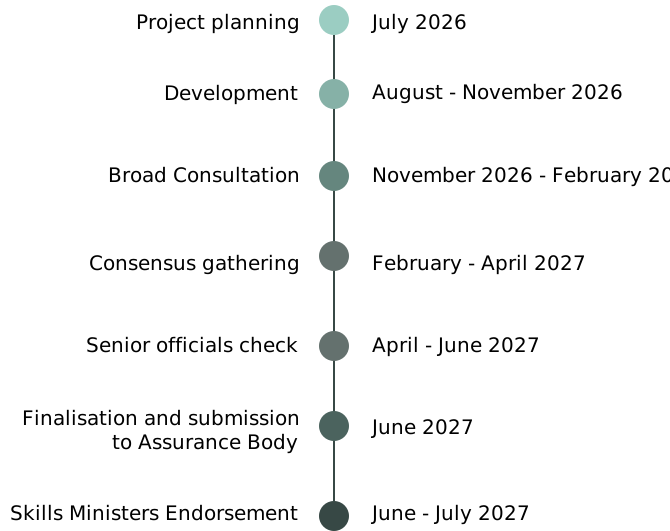
Stakeholder input is encouraged throughout this project and will help ensure training products reflect contemporary industry practice and workplace requirements. Draft materials will be developed in consultation with the Technical Committee and their networks, with opportunities for feedback during Broad Consultation (November 2026 to February 2027) and Consensus Gathering (February to April 2027).
FurnishingWorks, as part of its collaborative partnership with Skills Insight, will contact key organisations identified as having an interest in this project. If you are aware of an organisation that you think should be involved, please contact Stakeholder Engagement Manager Bianca Walters at [email protected]
This stage has not yet commenced.
During the development stage, key stakeholders, including subject matter experts, are engaged and consulted to gather further information and begin investigating potential solutions.
This stage has not yet commenced.
At the broad consultation stage, we present and discuss potential solutions, collecting feedback from a wide range of stakeholder across the country. It follows consultation with various stakeholders that has already taken place throughout the project.
This stage has not yet commenced.
As part of consensus gathering, we check our work with stakeholders to confirm that solutions are in line with expectations.
This stage has not yet commenced.
At the finalisation stage, final checks are conducted and the outcomes of the project are submitted to the Department for consideration. Following this, outcomes are published or enacted.